
Go big, or get left behind: what the industry's largest offtakes really change
For years, the open question around circular materials was whether the demand was truly there. It has been answered. In just over two years, three of the world's most recognizable brands – H&M Group, Nike,and Target – have committed close to USD 900 million to circular polyester, in the three largest offtake agreements the industry has ever seen, all signed with Syre.
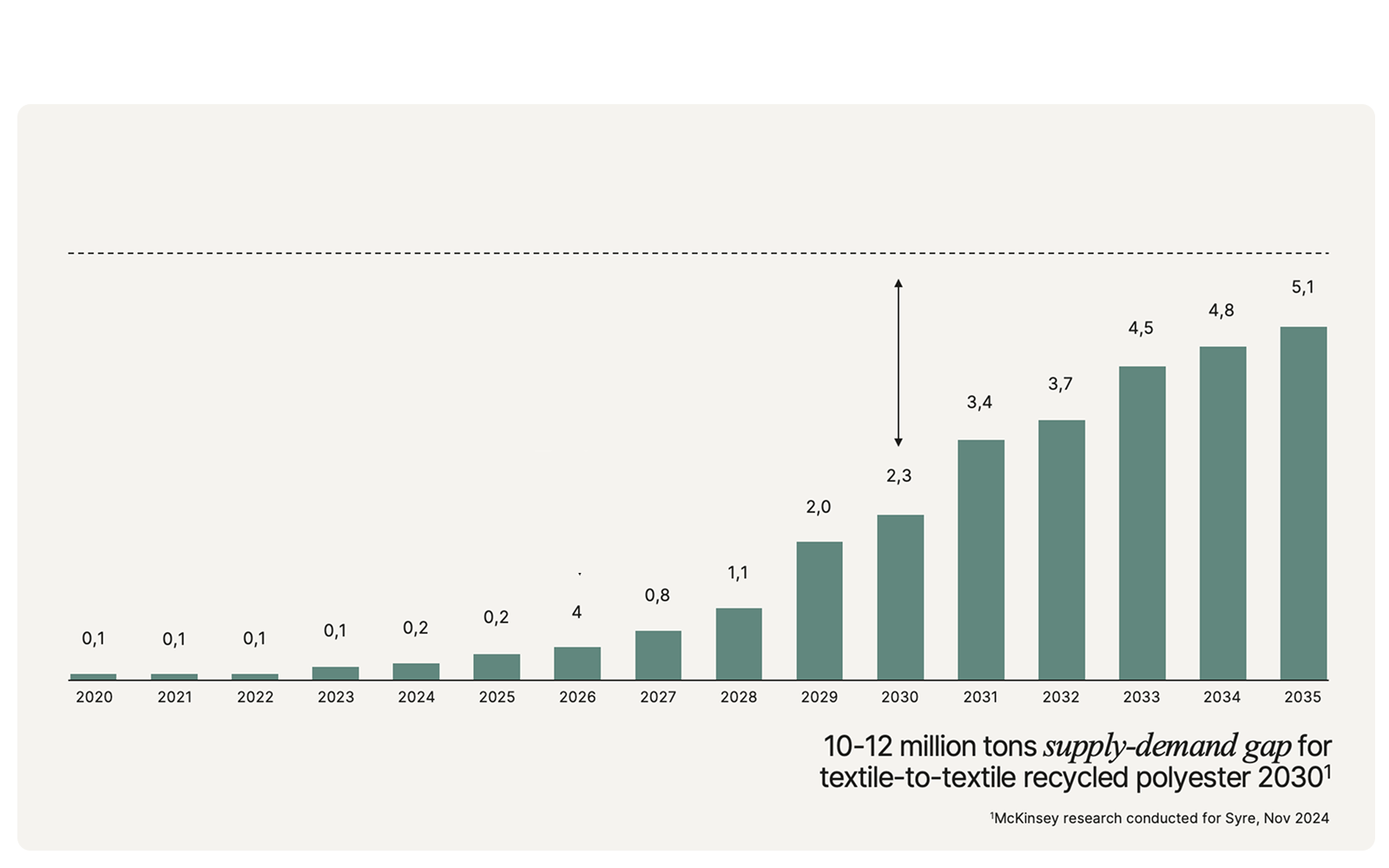
It is happening against a rare dynamic: demand for circular materials is rising while supply stays scarce. By 2030, demand for textile-to-textile recycled polyester is projected to reach around 14 million tonnes a year, against just 2–4 million tonnes of supply – a gap of 10–12 million tonnes, according to McKinsey research[1].These are not capsule collections or pilot projects. H&M Group's offtake agreement, announced at Syre's launch, is worth USD 600 million and covers a significant share of the group's long-term need for recycled polyester. Nike has named Syre its lead strategic supplier for textile-to-textile recycled polyester, with integration into its core performance lines. Target's expanded collaboration is expected to bring 70,000 metric tons of recycled polyester into high-volume categories like apparel and home. Different brands, different markets, but the same conviction: secure circular supply now, or risk being locked out later.
Why size matters
In an emerging industry, the size of a commitment is not just a commercial detail, but what makes everything else possible.
"To enable true scale, we need to build new factories, and factories depend on long-term commitments from big buyers. This type of agreement is an advanced market commitment. It’s the kind of signal that unlocks financing for the large plantsthe industry knows it needs to build," says Jad Finck, CCO at Syre.
The logic is a chain. Large offtakes translate into investment. Investment funds the infrastructure, including plants, feedstock systems and regional supply chains. That infrastructure lets circular polyester scale. Scale, in turn, is what makes the economics compelling: as volumes rise, circular polyester moves from a premium material toward a cost-competitive one. Size becomes investment, investment becomes scale, and scale turns circularity into a sound business case.
What changes with scale
When offtakes reach this magnitude, the entire risk profile of a project changes. A first-of-its-kind facility is an enormous undertaking, and long-term demand from established global brands is what de-risks the capital behind it. It is the difference between a promising technology and a bankable industrial project – and it shapes how big that first plant can be.
This is what stands behind Syre's first large-scale plant, set to break ground in Vietnam in 2027, and reach full-scale operations by 2030, with an annual capacity of around 150,000 tonnes of circular polyester. The brands that committed early are not betting on whether the technology works. They are helping build the supply chain that turns it into reality, and securing their place in it as supply tightens.
What this unlocks next
The effect compounds. Each major commitment makes the next one easier, shortens scaling timelines, and adds credibility to the entire category. It also shifts the conversation – from brands expressing interest in circular materials to integrating them into core products as strategy. As Sitora Muzafarova, VP Materials Supply Chain at Nike, puts it: “Our partnership with Syre representsa shift in our materials strategy and how we source.”
Regulation is pulling in the same direction. Across the EU and beyond, ecodesign rules andextended producer responsibility schemes are tightening expectations on recycled content, turning circularity from a voluntary commitment into a baseline of doing business. Committing to volume early is a way to get ahead of that curve, not just react to it.
And leadership is contagious.
“When a global brand and cultural leader like Nike takes a step like this, others follow. Consumers don't buy 'sustainable products' – they buy products they believe are great,” says Jad Finck.
As circular supply stays scarce and regulation tightens, the brands that secured volume first will hold a structural advantage, while those still waiting for proof may find the capacity already spoken for.
The lesson from these three agreements is one the industry is beginning to absorb: in the race to circularity, the first movers don't just go early – they go big.
[1] McKinseyresearch conducted for Syre, Nov 2024, based on top 450 apparel, top 25 automotive, and top 100 interior players, announced capacities and needs