

From ambition to investment: where EU textile policy actually stands
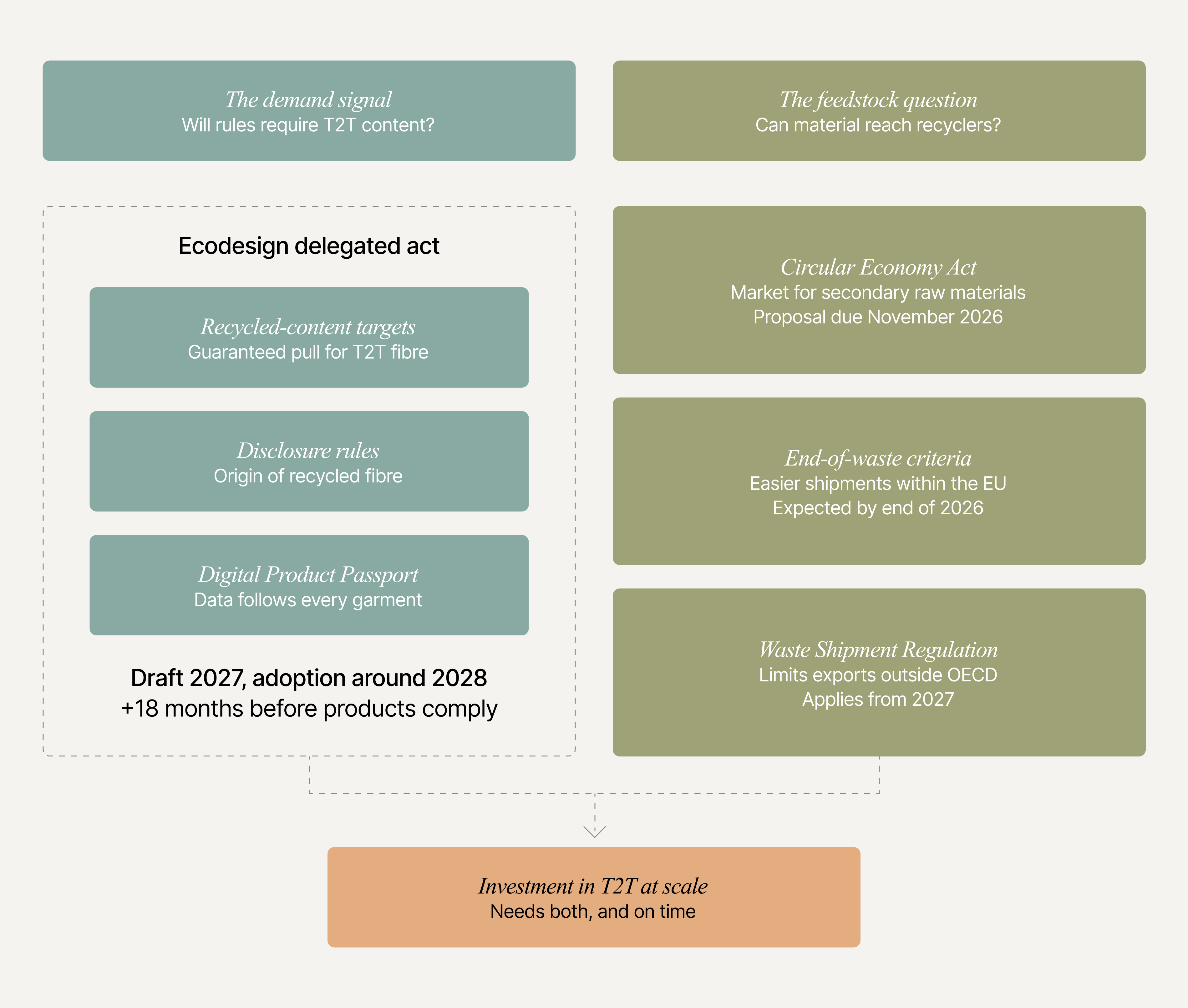
The conversation on textile circularity is no longer about whether the transition should happen, but whether policy and regulation can move quickly enough to create the demand signals needed for investment. Two things decide that. First,a demand signal: rules that actually require recycled, textile-to-textile content, so there is guaranteed pull for what recyclers produce. Second, feedstock: recyclable textile waste being treated as a raw material that can move to where it is recycled, rather than as waste to be contained. In this issue of the Fiber Forecast, we look at where the main EU files stand – from the Ecodesign Delegated Act that sets the demand signal, to the collection and trade rules that decide whether feedstock can reach recyclers.
1.The demand signal: will the rules require textile-to-textile (T2T) content?
Thesingle biggest lever for textile-to-textile (T2T) is mandatory recycled content– and how it is defined.
“The key file to drive demand for T2T materials is the ESPR Delegated Act on apparel. It presents a unique approach to translate the Ecodesign Regulation's circularity ambition into binding, market-entry requirements for recycled materials.” – T2TAlliance
ESPR– the delegated act for apparel. The Ecodesign for Sustainable Products Regulation (ESPR) is the product rule that will set Ecodesign requirements for appare lproducts – durability, recyclability, chemical use, traceability – and require every apparel product sold in the EU to carry a Digital Product Passport. What matters most for recyclers is its recycled-content regime, where two kinds of rules are on the table – what companies must achieve, and what they must disclose.
Targets (what they must hit):
- Industry discussions have included potential minimum recycled-content requirements, with different threshold levels currently being debated for polyester, nylon and cotton.
- The T2T Alliance is calling for closed-loop recycled-content thresholds to be introduced gradually, set per fibre category – cotton, man-made cellulosics, polyester and nylon – alongside a clear verification method and firm timelines to give investors legal certainty.
- Industry participants increasingly expect the Commission to avoid overly restrictive feedstock-origin requirements, due to the global nature of textilne waste streams.
Disclosure (what they must report):
- The origin and type of recycled material – post-consumer vs post-industrial, closed-loop or not – in growing detail.
The process is now entering a decisive phase: the Joint Research Centre's (i.e. the Commission’s in-house science and knowledge service) final milestone study is expected shortly, with the Impact Assessment consultations opening in parallel – a key window for the T2T industry to shape the recyclability and recycled-content rules. On the official timeline, the Commission aims to present a draft in 2027 and adopt the act by the beginning of 2028, followed by a transition period ofat least 18 months before products must comply and carry a Digital Product Passport. Some in the industry, Syre included, consider early 2028 the more realistic adoption date. Traceability and chain-of-custody verification remainhard, and some fear a strict mass-balance approach.
2.The feedstock question: can the material reach recyclers?
A demand signal is worth little if recyclers cannot get the material. Two files decide whether feedstock can flow.
The Circular Economy Act (CEA). The EU's forthcoming CEA will shape the market for secondary raw materials – how waste is defined and how recycled material can move across borders. For T2T it is pivotal: recyclers depend on recovered textiles counting as a raw material that can flow freely, not waste to be locked down. Originally planned for September, it has been delayed until November, after the Commission's own scrutiny board sent the proposal back – questioning, among other things, whether it did enough to address the demand side: whether there will be sufficient, predictable demand for the secondary materials all this policy is meant to create. The T2TAlliance is hopeful the CEA will include measures tailored to the textile value chain – warning that without them, textile recycling risks being left behind materials like plastics and metals, where markets are already more mature.
The Waste Shipment Regulation and End-of-waste criteria for textile waste. This governs feedstock access directly. As textile-to-textile recycling scales, this will become increasingly important. The industry argues that recyclable textile waste should count as a secondary raw material, not waste – and that efficient cross-border trade, especially between Europe and Asia, is what a global circular system needs. From 2027, however, the Waste Shipment Regulation will restrict exports of non-hazardous waste to non-OECD countries, which could limit flows with parts of Asia. Similarly, the adoption of End-of-waste criteria for textile waste, expected before the end of the year, could facilitate shipment of feedstock between EU Member States

3.We need to accelerate implementation
The framework is falling into place, but ambition on paper is not the same as implementation, speed and scale in practice. Syre’s Stina Billinger, heading up Sustainability and Public Affairs, summarizes it:
“Textile recyclers have become increasingly organized. Through the creation of the T2T Alliance and active engagement with policymakers, the sector is pushing for a level of ambition that can support aviable market for textile-to-textile recycled materials. The coming months willshow whether the Commission is prepared to deliver the measures needed toenable the industry's long-term growth.”